
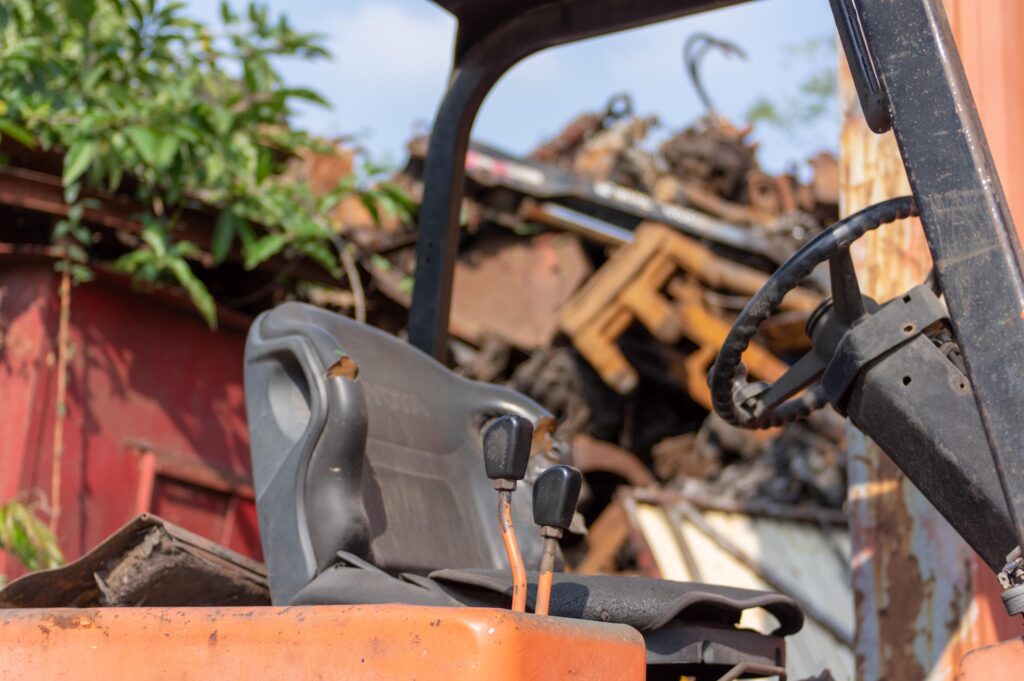
In any warehouse, distribution center, or manufacturing plant, there’s a specific sound. It’s the hum of activity, the beeping of equipment, the whir of electric motors, and the steady thrum of internal combustion engines. It’s the sound of productivity. But there’s another, more terrifying sound| silence. It’s the sudden, echoing quiet that happens when a critical piece of material handling equipment goes down.
We’ve been on-site at countless facilities, and we’ve seen that exact moment. It’s 9:00 AM. A truck is at the dock, the driver’s logbook is ticking, and the forklift that was supposed to be loading it is dead on the floor with a hydraulic leak. The operator is standing by, helpless. The shipping manager is on the phone, trying to find a workaround. That, right there, is forklift downtime.
For many businesses, a broken forklift is seen as a simple maintenance issue, an isolated inconvenience. From our decades of experience in the forklift service industry, we can tell you this view is dangerously wrong. Forklift downtime is not a maintenance problem. It is a financial catastrophe that sends a destructive ripple effect through your entire operation. It’s a silent killer of profits, a destroyer of schedules, and a major source of operational stress.
In this post, we will explore the full, cascading impact of forklift downtime, moving from the obvious costs to the hidden, long-term damages that most businesses fail to calculate. More importantly, we’ll show you how to move from a reactive state of panic to a proactive state of control.
Immediate Financial Bleeding | Obvious Costs of Forklift Downtime
When a forklift stops, the most visible costs are the ones that hit your ledger immediately. These are the expenses you can easily track, and they add up with alarming speed.
Halted Production and Idle Labor
This is the first and most direct cost. The moment that forklift stops, your payroll keeps running.
- The Operator: You are paying a trained, skilled operator to stand and wait.
- The Support Staff: Who else is affected? What about the three packers on the line who are now out of work because they can’t get the next pallet? What about the truck driver who is now on the clock, waiting?
- The Supervisor: Your manager or supervisor is now pulled away from high-value tasks (like planning the next shift) to deal with this single emergency.
Let’s put a number to this. Say your forklift operator earns $25/hour (with benefits) and the four-person team they support earns $20/hour each. That’s $105 in direct, idle labor costs for every hour that machine is down. If it takes four hours to get a technician on-site and get the machine running, you have just paid $420 for zero warehouse productivity.
Emergency Forklift Repair Costs
The second obvious cost is the repair itself. An emergency, “I need you now!” service call is always more expensive than a scheduled maintenance visit.
- Trip and Diagnostic Fees: You will pay a premium for a technician to drop what they are doing and drive to your facility.
- Overtime Labor: If that failure happens at 4:00 PM on a Friday, you are now looking at overtime rates to get it fixed.
- Hot-Shot Parts: If the technician doesn’t have the specific part on their van, it may require an expedited, overnight shipping fee to get it from the manufacturer, adding hundreds of dollars to the bill.
This reactive approach to forklift repair is the most expensive way to maintain your fleet. You are paying a premium for a problem that, in many cases, could have been prevented for a fraction of the cost.
A Hidden Ripple Effect | How the Impact of Forklift Downtime Spreads
This is where the true cost of downtime reveals itself. The $420 in idle labor and the $800 emergency repair bill are just the beginning. The real damage lies in the cascading failures that now move through your business, impacting everything from your schedule to your reputation.
Shipping Delays and Missed Deadlines
That truck at your dock? It had a 10:00 AM appointment. It’s now noon. That driver might now run out of available driving hours, forcing them to park overnight, or they may miss their delivery window at the final destination.
This single failure results in:
- Freight Detention Fees: The carrier will charge you a hefty hourly fee for making their driver wait.
- Missed Delivery Slots: Your customer (e.g., a major retailer’s distribution center) has a rigid receiving schedule. If you miss your 3:00 PM slot, you may be rejected and told to come back tomorrow, or even next week.
- Rescheduling Chaos: Your entire shipping-and-receiving schedule for the rest of the day is now thrown into chaos, creating a backlog that will take days to clear.
Increased Safety Risks
This is one of the most serious, yet overlooked, consequences. When a team is under pressure and their primary tool is broken, they get desperate. This desperation leads to dangerous, un-safe workarounds.
We’ve seen it all:
- Using the Wrong Equipment: A manager, in a panic, might ask an operator to “just quickly” move a 4,000-pound pallet with a manual pallet jack rated for 2,500 pounds. This is how you destroy equipment, damage product, and cause serious injuries.
- Manual Lifting: Workers may try to manually lift or move heavy items that the forklift was supposed to handle. This is a direct path to back injuries, smashed fingers, and workers’ compensation claims.
- “Quick Fixes”: An untrained operator might try to “fix” the forklift themselves, bypassing safety features or jury-rigging a hydraulic line. This can lead to catastrophic failure, load drops, or fires.
Damaged Customer Relationships and Reputation
This is the cost that can truly sink a business. Your customers rely on you to deliver your product on time, every time.
- The First Failure: The first time you call a customer to say, “Your shipment is going to be a day late because our forklift broke down,” they will likely be understanding.
- The Second Failure: The second time it happens, they will be annoyed.
- The Third Failure: The third time, they will be on the phone with your competitor.
In today’s fast-paced logistics world, reliability is everything. The impact of forklift downtime is a direct hit to your reputation as a dependable partner. You can’t put a price on that lost trust, but you will feel it when that multi-million dollar contract is not renewed.
Accelerated Wear on Other Equipment
When one forklift in a fleet of five goes down, the other four don’t just pick up the slack—they are run into the ground. You are now putting 25% more work and strain on your remaining material handling equipment. Operators will rush, run them harder, and skip breaks to try and keep up. This accelerated use means you are burning through the lifespan of your other assets, leading to — you guessed it — more forklift downtime as those machines begin to fail under the strain.
Why Forklift Downtime Happens in the First Place
We now understand the devastating costs. But why does it happen? Almost universally, forklift downtime is not a random “act of God.” It is a predictable, and preventable, outcome of a flawed maintenance philosophy.
Reactive Maintenance | The “Fix It When It Breaks” Fallacy
The most common reason for downtime is that the business is operating on a reactive, or “break-fix,” maintenance model. This model treats maintenance as an expense to be avoided, rather than an investment to be made.
This philosophy guarantees failure. Why?
- It Guarantees Maximum Disruption: The machine will always break at the worst possible time (e.g., in the middle of loading a critical shipment) because that is when it is under the most stress.
- It Guarantees Maximum Cost: As we’ve established, an emergency forklift repair is far more expensive than a scheduled service.
- It Guarantees Compounding Damage: A small, silent problem (like a $20 bearing) is ignored until it seizes, destroying a $2,000 axle assembly in the process.
Neglected Daily Inspections
OSHA requires that every forklift be inspected by the operator before the start of their shift. (Consider linking to OSHA’s forklift standard 1910.178(q)(7) for more information). This is not just a bureaucratic rule; it is the first line of defense against downtime.
Too often, operators, in a rush, pencil-whip the form or skip it entirely. They fail to notice the “spongy” brake pedal, the slightly worn tire, or the small fluid drip on the floor. That small drip is a warning. Ignoring it is what leads to a catastrophic hydraulic failure hours later.
Using the Wrong Equipment for the Job
We often see downtime caused by a simple mismatch. A business buys a forklift based on price, not application. They use a solid-tire, indoor electric forklift on a rough asphalt yard. That machine’s suspension and electronics are not designed for that environment. It’s not a matter of if it will break down, but when. (Consider linking to our [Forklift Sales] page to find the right lift for your application).
Shift from Reactive to Proactive with 4K Lifts
You cannot eliminate 100% of equipment failures, but you can get remarkably close. The solution is to change your entire philosophy. You must stop reacting to downtime and start preventing it. This is where a partnership with a dedicated service provider like 4K Lifts becomes a strategic advantage.
The Power of Planned Maintenance Programs
This is the single most effective strategy for protecting your operations. A Planned Maintenance Program (or PM Program) is a core service we provide. It is an agreement where one of our certified technicians comes to your facility on a pre-set schedule (based on your usage hours and operating environment) to service your fleet.
This simple act changes everything:
- We Find Problems When They Are Small: During a PM service, our technician isn’t just changing the oil. They are inspecting every critical component—hoses, chains, brakes, tires, and fluid levels. They will spot the slightly worn hose before it bursts.
- Scheduled, Not Disruptive: We perform this forklift maintenance during your slow periods, on weekends, or after hours. The service is scheduled around your needs, creating zero disruption to your peak warehouse productivity.
- Budget Predictability: A PM Program moves your maintenance spending from a volatile, unpredictable emergency expense to a fixed, predictable line item in your budget. You know what you’ll be spending, which makes financial planning simple.
Partnering with a Responsive Forklift Repair Team
Even with a great PM program, acute issues can arise. A new operator might accidentally back into a rack. When this happens, your response time is what matters.
This is the second half of the solution. You need a forklift repair partner who treats your emergency like their own. When you call 4K Lifts, you’re not just put on a waiting list. We dispatch a fully-stocked service van, often the same day, with the goal of getting you up and running on the first visit. This speed turns a potentially multi-day catastrophe into a minor, multi-hour inconvenience.
Calculating Your True Cost of Downtime | A Simple Formula
We challenge all of our clients to do this simple math. Don’t just guess. Run the numbers for your own operation.
Cost of Downtime (per hour) = (Idle Labor Cost) + (Lost Revenue)
- Calculate Idle Labor Cost (per hour)
- (Operator’s fully-loaded hourly wage) + (Hourly wage of all support staff who are also idled)
- Example: 1 Operator ($25) + 3 Packers ($20 each) = $85/hour
- Calculate Lost Revenue (per hour)
- This is the revenue generated by that forklift’s activity.
- (Units moved per hour by that lift) x (Revenue per unit OR Value of that activity)
- Example: 8 units/hour moved x $500 revenue/unit = $4,000/hour
Your Shocking Total (per hour) = $4,085
In this conservative example, every single hour your forklift is down costs your business over $4,000. Now, add your emergency forklift repair bill and any freight penalties. A single four-hour breakdown could easily cost you over $17,000.
Now, compare that $17,000 loss to the small, fixed cost of a quarterly Planned Maintenance Program. The math is undeniable.
Conclusion | Downtime is a Choice, Not an Inevitability
The impact of forklift downtime is not just an equipment problem. It is a critical business problem that directly attacks your operational costs, your warehouse productivity, and your customer’s trust.
The “fix-it-when-it-breaks” model is a losing strategy. It is a choice that leaves you vulnerable to massive, unpredictable costs and constant operational chaos.
We at 4K Lifts believe in a different approach. We partner with businesses to make downtime a relic of the past. Through proactive Planned Maintenance Programs, expert forklift repair services, and a deep understanding of your operational needs, we help you replace the sound of silence with the steady, reliable hum of productivity.
Stop gambling with your operations. Don’t wait for the next breakdown to calculate your cost of downtime.
Contact 4K Lifts today to schedule a free, no-obligation assessment of your forklift fleet. Our experts will analyze your equipment and usage to design a Planned Maintenance Program that fits your budget and protects your business from the catastrophic impact of forklift downtime. Call us now and let’s build a more productive and reliable future.
Frequently Asked Questions
Q. What is the most common cause of forklift downtime?
- From our experience, the most common causes are failures related to the battery (on electric lifts), tires (wear, flats, chunking), and hydraulic systems (leaks, pump failures). Nearly all of these are preventable with regular forklift maintenance.
Q. How can a Planned Maintenance Program (PM Program) prevent downtime?
- A PM Program is proactive. Our technicians inspect, lubricate, and service critical components on a regular schedule. This allows us to spot small issues, like a worn hose, a low fluid level, or a fraying belt, and fix them before they can cause a major, operation-stopping breakdown.
Q. What is the difference between forklift maintenance and forklift repair?
- Forklift maintenance is proactive, scheduled, and preventive. Its goal is to prevent downtime and keep the machine in optimal condition. Forklift repair is reactive. It’s the “break-fix” service you call for after the machine has already failed and your operation is stopped. Maintenance is always more cost-effective than repair.
Q. How often does my material handling equipment need a PM service?
- This depends entirely on your application and usage. A forklift running 24/7 in a harsh, dusty environment will need service much more frequently than a lift that runs only a few hours a day in a clean warehouse. We at 4K Lifts will create a custom PM schedule (e.g., every 90, 180, or 250 hours of use) that is tailored specifically to your needs.