
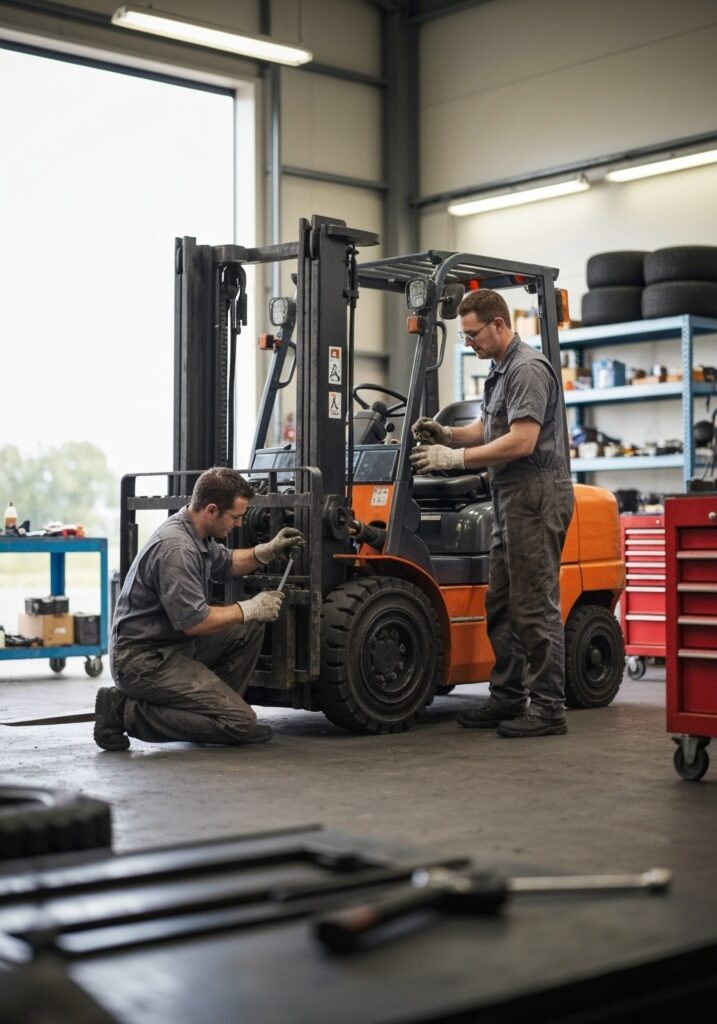
Imagine walking onto your warehouse floor at peak operational capacity. The rhythm of the facility is humming—pallets moving, trucks loading, scanners beeping. It looks productive. But if you could see the air composition as clearly as you see the racking, the picture might look very different.
For decades, the material handling industry has relied on the raw power of internal combustion (IC) engines. The rumble of a propane or diesel forklift has been the soundtrack of logistics. However, that sound comes with a byproduct that we can no longer afford to ignore: emissions.
At 4K Lifts, we have visited thousands of facilities where the air quality — and by extension, the carbon footprint — is an afterthought. But with tightening regulations like the EPA Tier 4 standards and California’s aggressive zero-emission mandates, the environmental impact of your fleet is moving from a background issue to a boardroom priority.
Let’s explore the true impact of forklift emissions, not just on the planet, but on your workforce and your bottom line. We will break down the science, the regulations, and the actionable steps you can take to build a cleaner, more sustainable future.
Understanding the “Exhaust” of Logistics
When we talk about forklift emissions, we are often referring to a cocktail of gases and particulate matter expelled from the tailpipe of IC engines. While a single forklift might seem insignificant compared to a semi-truck, the cumulative effect of a fleet operating indoors for 16 to 20 hours a day is staggering.
The primary pollutants include:
- Carbon Monoxide (CO): A colorless, odorless gas that reduces the blood’s ability to carry oxygen.
- Nitrogen Oxides (NOx): A major contributor to smog and respiratory irritation.
- Particulate Matter (PM): Tiny particles of soot and metal that can penetrate deep into the lungs.
- Hydrocarbons (HC): Unburned fuel that reacts with sunlight to form ground-level ozone.
Unlike cars that spend 95% of their lives parked, forklifts are workhorses. A single propane forklift can emit as much carbon monoxide as dozens of idling cars if not properly tuned. This creates a localized environmental crisis within the four walls of your facility, contributing heavily to your company’s overall carbon footprint.
The Human Cost | Indoor Air Quality and Health
Before we look at the global environment, let’s look at the immediate environment: your warehouse air. Indoor air quality is a critical safety metric that is often overlooked until an incident occurs.
The Silent Danger of Carbon Monoxide
Carbon monoxide poisoning is a real and present danger in facilities using internal combustion forklifts. OSHA records roughly 19 serious incidents involving CO in industrial settings annually, but minor exposure often goes unreported. Symptoms like headaches, dizziness, and fatigue are frequently dismissed as “end-of-shift tiredness,” when in reality, they are signs of mild poisoning.
This directly impacts productivity. A worker fighting off the effects of poor air quality is slower, less focused, and more prone to errors. We advise our clients to treat air quality not just as a compliance checkbox, but as a productivity tool.
Ventilation Requirements
If you are running IC trucks, warehouse ventilation is not optional. The general rule of thumb is that for every single 60-horsepower propane forklift operating indoors, you need approximately 5,000 cubic feet per minute (CFM) of air exchange to dilute emissions to safe levels. Achieving this in a sealed, climate-controlled warehouse is energy-intensive and expensive, further adding to the environmental cost.
The Numbers | Internal Combustion vs. Electric
The debate between internal combustion forklifts and electric forklifts has traditionally been about power vs. price. Today, it is about emissions.
Recent studies indicate that the logistics and transport sector contributes over one-third of global CO2 emissions. Within that, material handling equipment plays a massive role.
The Diesel and Propane Reality
A standard diesel forklift consumes roughly 2-3 liters of fuel per hour. This translates to approximately 5,000 to 8,000 grams of CO2 emitted per hour of operation. Over a 2,000-hour work year, a single truck can generate upwards of 16 metric tons of CO2.
The Electric Advantage
By contrast, electric forklifts produce zero tailpipe emissions. While there is a carbon cost to manufacturing the battery and generating the electricity (Scope 2 emissions), the lifecycle analysis is overwhelmingly in favor of electric.
- Lithium-Ion Technology: Modern lithium-ion battery technology has widened the gap further. Unlike lead-acid batteries, which require gassing periods during charging that release hydrogen, lithium-ion units are completely sealed.
- The Grid Factor: Even when charged on a “dirty” electrical grid (coal/gas mix), an electric forklift generates roughly 75% less CO2 over its lifecycle compared to an IC equivalent.
The Regulatory Landscape is Changing
If the moral or health arguments don’t compel you to act, the law will. Governments worldwide are cracking down on off-road diesel emissions, and the material handling industry is in the crosshairs.
EPA Tier 4 Standards
The EPA Tier 4 standards have revolutionized diesel engine manufacturing. These regulations require a 90% reduction in PM and NOx compared to previous generations.
To achieve this, modern diesel forklifts utilize complex emission control systems like Diesel Particulate Filters (DPF) and Selective Catalytic Reduction (SCR) requiring Diesel Exhaust Fluid (DEF).
While cleaner, these systems add cost and maintenance complexity. A ignored DPF warning light can send a truck into “limp mode,” halting production.
The California Catalyst: Zero-Emission Mandates
California is often the bellwether for environmental policy. The California Air Resources Board (CARB) has introduced the zero-emission forklift mandate, which aims to phase out the sale of large spark-ignition (LSI) forklifts (propane and gas) by 2026 for many fleets.
While this technically applies to California, we are seeing multi-state operators adopt these standards nationally to simplify their fleet management. Manufacturers are also shifting R&D budgets almost entirely to electric, meaning the “best” IC trucks may have already been built.
The Business Case for Sustainable Material Handling
At 4K Lifts, we believe that sustainable material handling is synonymous with profitable material handling. Implementing a green strategy is not just about saving the polar bears; it is about saving dollars.
1. Reduced Fuel Volatility
Fossil fuel prices are volatile. Electricity prices, while rising, are far more stable and predictable. Transitioning to electric removes the variable of spiking propane costs from your operational budget.
2. Lower Maintenance Costs
IC engines have hundreds of moving parts — pistons, spark plugs, transmission fluids, catalytic converters. Electric motors have essentially one moving part: the rotor. By eliminating the engine, you eliminate the emissions and the maintenance associated with controlling those emissions.
3. Corporate Responsibility and Brand Image
Your customers are watching. Consumers and B2B partners are increasingly demanding green logistics throughout their supply chain. Being able to market your facility as a “zero-emission warehouse” is a competitive differentiator.
Actionable Steps to Reduce Your Fleet’s Impact
You do not have to scrap your entire fleet tomorrow to make a difference. Here is a step-by-step approach to lowering your emissions profile starting today.
Step 1: Optimize What You Have
If you must run IC trucks, ensure they are tuned to perfection.
- Regular Tuning: A poorly tuned propane carburetor can emit 10x the carbon monoxide of a tuned one.
- Idle Reduction: Implement telematics to track and reduce idle time. An idling forklift is burning fuel and creating emissions for zero productivity.
Step 2: Hybridize Your Fleet
Consider a “right-typing” approach. Do you really need a diesel truck for indoor/outdoor use, or could a high-voltage electric pneumatic truck do the job?
- Start by replacing your oldest, dirtiest offenders (Pre-Tier 4 diesels) with electric units.
- Use electrics for the core indoor shifts and reserve IC trucks for the heavy outdoor yard work where ventilation is less of an issue.
Step 3: Invest in Telematics
Forklift fleet management software gives you the data to see your true environmental impact. By tracking hours, fuel usage, and impact data, you can calculate your exact carbon output and set reduction goals.
Step 4: Plan for Infrastructure
Moving to electric requires infrastructure. You need to assess your electrical panel capacity.
Opportunity Charging: With lithium-ion, you can install chargers throughout the facility (break rooms, docks) rather than a centralized battery room, reducing travel time and improving efficiency.
Embracing the Future of Clean Lifting
The impact of forklift emissions extends far beyond the tailpipe. It infiltrates the lungs of your workers, the efficiency of your operations, and the health of our global environment. While the challenge is significant, the solution offers a pathway to a more modern, cost-effective, and humane way of doing business.
The era of the “smoking” forklift is coming to an end. Whether driven by fleet sustainability goals, employee health concerns, or government mandates, the transition to cleaner technologies is inevitable.
At 4K Lifts, we are committed to helping you navigate this shift. We understand that moving away from the internal combustion engines you have trusted for years can feel risky. But the technology is ready. Today’s electric lifts match the torque, lift capacity, and durability of their IC predecessors, without the toxic cloud.
We have the data, the technology, and the expertise to turn your fleet into a model of sustainability. The question is no longer if you should reduce emissions, but how quickly you can start.
By proactively addressing the impact of forklift emissions, you are protecting your greatest assets: your people and your future.
Are you ready to breathe easier? Call on 4K Lift today and join us — greet the future on your own terms.
Frequently Asked Questions
Q. What are the main pollutants emitted by internal combustion forklifts?
Internal combustion forklifts primarily emit carbon monoxide (CO), nitrogen oxides (NOx), particulate matter (PM), and hydrocarbons (HC). These pollutants contribute to poor indoor air quality and global greenhouse gas levels.
Q. How do electric forklifts compare to propane forklifts regarding carbon footprint?
Electric forklifts have zero tailpipe emissions, making them significantly cleaner at the point of use. Even when accounting for electricity generation and battery manufacturing, studies show that electric forklifts have a significantly lower total carbon footprint over their lifecycle compared to propane or diesel trucks.
Q. What are the EPA Tier 4 standards for forklifts?
EPA Tier 4 standards are strict federal regulations that mandate significant reductions in exhaust emissions (specifically PM and NOx) for new off-road diesel engines. Manufacturers must use advanced technologies like catalytic converters and high-pressure fuel injection to meet these limits.
Q. Are there regulations banning gas forklifts?
Yes, in certain regions. For example, the California Air Resources Board (CARB) has adopted mandates that will phase out the sale of most new large spark-ignition (propane and gasoline) forklifts starting in 2026, pushing fleets toward zero-emission alternatives.
Q. Can existing internal combustion forklifts be made cleaner?
Yes. Regular maintenance, specifically engine tuning and changing air filters, can drastically reduce harmful emissions. Additionally, installing aftermarket catalytic converters and using telematics to reduce unnecessary idling can improve the emissions profile of an existing fleet.