
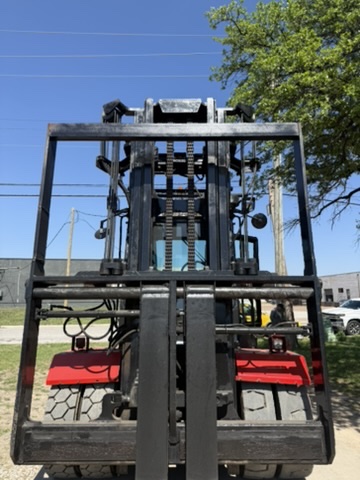
A forklift’s hydraulic system is like its musculoskeletal system. They’re powerful networks of hoses, cylinders, valves, fittings, and seals that lift, tilt, and steer your business forward.
Even though they’re designed to withstand tough, high-volume duty cycles, hydraulic systems degrade over time. Exposure to excessive Dallas heat, for instance, means owners must perform maintenance more frequently than is typical.
No operations manager wants a hydraulic failure — when your lift truck takes an unexpected siesta, it means downtime throughout your warehouse. Take a proactive approach towards maintaining your hydraulic systems and you can turn that used forklift into a safe, productive machine for years.
Shop Used Forklifts Powered By Reliable Hydraulics
What role does hydraulic fluid play in detecting pressure leaks?
It all starts with Pascal’s Principle. When pressure is exerted on a fluid in a closed system, that pressure is distributed equally to every part of that system. Hydraulic systems are amazing because they let a tiny engine or electric motor move thousands of pounds vertically and horizontally with ease. But because hydraulics typically operate at such high pressures, even the smallest hole in your system can cause a loss of power.
Hotter summers in Texas or high humidity along the southern coast can really do a number on your hydraulic oil. Heat causes oil to thin out and become less viscous. As your oil thins out, its lubricating properties weaken and the friction inside your cylinders will increase. As friction increases, your whole system has to work harder — which puts unnecessary strain on your pump and valves.
Swap out your filters and always keep an eye on your hydraulic fluid, by using fluid analysis as part of your business’s financial intelligence.
What are visual clues that cylinders or hydraulic hoses are wearing out?
The biggest hydraulic issues are typically visible to the naked eye during your daily pre-shift inspection. The first thing you want to look for is an abundance of wetness on the chrome-looking section of your lift or tilt cylinder. A normal amount of hydraulic fluid looks like it has a thin film of oil covering it at all times, but it should never have drops of oil coming from the seals or pooling up at the base of the cylinder itself.
Another place managers should inspect closely: hydraulic hoses. These rubber tubes transfer hydraulic fluid from one part of the system to another and are often exposed to extreme movements and spikes in pressure. Inspect these hoses for any abnormalities, like bubbling or wear and tear of the outside casing.
If any of the internal supporting wires that run through your hydraulic hoses look damaged or worn, you need to replace them immediately. Hydraulic hoses operate under intense pressure and if the outer layer of your hydraulic hose gives way, you’ll be changing an awful lot of hydraulic fluid.
Test Tip | Checking for Slow Leaks
If you feel like you may have a slow leak but can’t quite see it, take a clean rag and wipe down all the hydraulic connections and cylinders. Now, move your masts through their complete upward and downward motion three times. Grab your rag and look for new spots of oil. If they appear, you’ve got a leak that needs to be fixed.
What are some audible cues and abnormal mast movements to look out for?
If your hydraulic system is working correctly, it should make a smooth, consistent low hum. If you begin to hear squealing or what sounds like metal chattering when you raise your forks, you may have aeration in your system.
Aeration occurs when tiny bubbles of air become trapped in your hydraulic system. Not only is this annoying to listen to, but because air is compressible, it will make your hydraulics feel “spongy” and your mast move erratically.
Watching Out for Fork Drift
Let’s say you have an older used forklift and it begins to drift — the forklift forks slowly lower on their own while they’re holding a load. This is dangerous, and it’s one of the main checks of an OSHA compliance audit on your warehouse. If your mast drifts, either your control valve has an internal leak or your lift cylinder seals are shot. Bottom line: if your mast can’t hold a stable load, your forklift needs to be taken out of service until your next bi-yearly inspection and repaired.
Hydraulic Maintenance Compliance Quiz | 30 Seconds
- Can the mast hold a rated load at the maximum height for ten minutes with less than a half-inch of drift?
- Do all the hydraulic control levers snap back to neutral on their own after you let go?
- Is your hydraulic fluid clear, with an amber tint?
If any of these answers are negative, you need maintenance immediately.
How does weather in your region affect hydraulic seals?
Humidity and salt are the two worst things for hydraulic systems. Salt can really eat away at the chrome that covers the ram of your lift cylinder. Once the chrome develops pits (dents), every time you move your ram up and down it’s like using a file on your rubber seals until they’re gone. Learn to protect your hydraulics from Florida humidity or Texas heat by performing preventative maintenance twice a year.
Summertime in Dallas can get brutal. When rubber components inside your hydraulic system are exposed to excessive heat, they become brittle and can’t form a pressure-tight seal. Businesses in the Dallas area should make it a priority to change the seals and flush the system before the summer months and humidity hit.
Call or stop by 4K Lifts for High-Quality Hydraulics
Now that you know how to keep your warehouse running, let’s talk about keeping it full. Running smooth, precision hydraulics is key when it comes to operating a forklift safely, especially in a narrow aisle warehouse.
At 4K Lifts, we understand that your hydraulic system is only as good as your maintenance. That’s why we only offer the best used forklifts powered by reliable hydraulics. Located in Dallas with over 35 years of experience in the industry.
We pride ourselves on letting our inventory speak for itself. Not only is our used forklift inventory one of the largest in the nation, we have also tested every single hydraulic system — twice. We are so confident you’ll be satisfied with your machine that we offer a 30-day exchange and comprehensive lift reports on every forklift we sell. Our bilingual staff is eager to help you find that perfect fit, both machine-wise and in terms of maintenance, to eliminate downtime in your shop.
Need a bi-yearly inspection? Emergency repair? No problem! We offer our customers flexible financing options and the technical expertise to keep your warehouse moving no matter the season. Reach out today.
FAQ
Q. My hydraulic fluid is turning a milky white color — what’s going on?
Milky hydraulic fluid is a leading sign you have water contaminating your system. This typically happens in areas with high humidity. Water in your system promotes rust and decreases your fluid’s ability to lubricate and protect your pump. You’ll need to flush your entire system and replace all of your fluid.
Q. How frequently should I change the hydraulic filters on my used forklift?
We recommend inspecting your filters during every 250-hour service interval. You should be changing your hydraulic filters at least once a year. If you’re located in an area that gets dusty often, like Dallas, you’ll need to change your filters more often. Dust and grime can make their way into your valve bodies, which wears out your filters more quickly.
Q. Can I mix different brands of hydraulic oil together?
You should never mix different hydraulic oils. Although they may be the same viscosity, different brands use different additives that, when mixed, can cause your oil to foam or break down.