
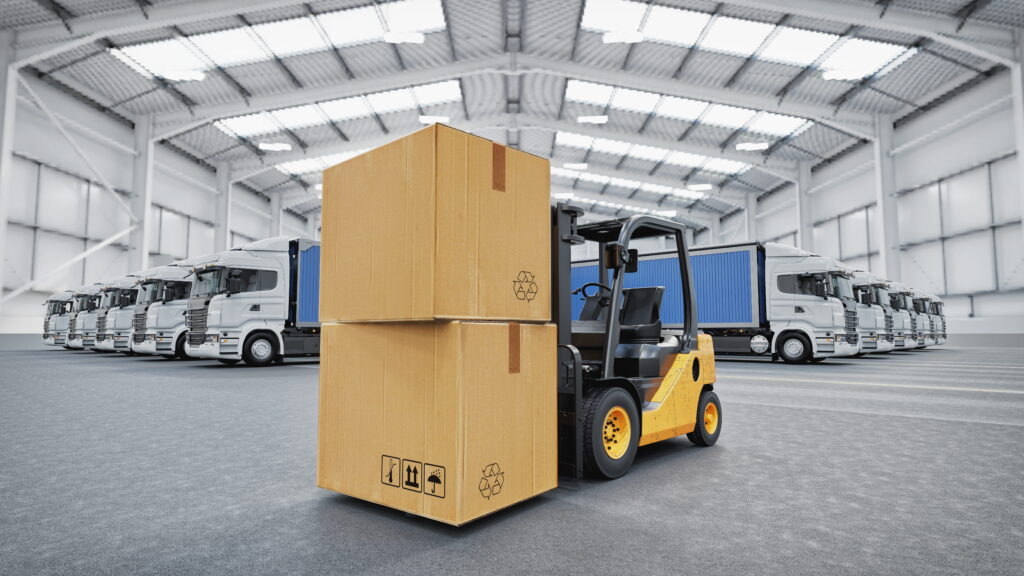
Operating a forklift is a high-stakes balance between power and physics.
It’s not entirely about moving a pallet from point A to point B, it’s also about maintaining that delicate equilibrium. When we discuss forklift safety, the conversation inevitably turns toward the “stability triangle” and the critical nature of the load center.
Ignoring these principles is the fastest way to cause a tip-over, which remains one of the leading causes of workplace injuries in the material handling industry.
Let’s take a deep dive into the mechanics of forklift stability and get clear on how it works. We’ll explore how to calculate capacity, how the center of gravity shifts during operation, and the step-by-step measures we must take to keep our operators safe and our inventory intact.
Fundamentals of Forklift Load Centers | Defining the Pivot Point
To operate safely, we must first define what a load center actually is. Simply put, it’s the horizontal distance from the vertical face of the forks to the center of gravity of the load.
In the United States, the standard load center for most sit-down counterbalanced forklifts is 24 inches. (This is assuming a standard 48-inch square pallet with its weight evenly distributed.)
When we pick up a load longer than 48 inches, or weight is shifted toward the front of the pallet, the load center increases.
As the load center moves further from the forklift’s fulcrum (front wheels), your effective lifting capacity decreases.
Think of it like holding a gallon of milk. It’s easy to hold against your chest, but as you extend your arm outward it feels significantly heavier — and pulls your body forward. This is the exact mechanical stress on a forklift when the load center is mismanaged.
The Stability Triangle | Managing the Center of Gravity
Cars have a four-point suspension system, balancing out weight between its four wheels. But a forklift typically operates on a three-point suspension. This is what we call the stability triangle.
Two points of the triangle are located at the ends of the front axle (the drive wheels), and the third point is the pivot pin in the center of the steer axle (the rear wheels).
The center of gravity in this system is the point where the weight of the forklift and the weight of the load meet.
As long as the combined center of gravity stays within the boundaries of this triangle, your truck will stay upright. Here’s the trick: this point is constantly moving. Whenever we accelerate, or brake, or tilt the mast, that center of gravity shifts. Likewise, if we turn too quickly or carry a load too high, that imaginary center of gravity can easily move outside the triangle, leading to a tip-over.
Factors That Influence Forklift Stability | Beyond the Load
Remember, the rated capacity on the lift’s data plate is only true under ideal conditions. In daily operations, several variables can compromise forklift stability:
- Load Height: The higher you lift a load, the less stable the forklift becomes. This raises the center of gravity, making the stability triangle effectively smaller and more sensitive to movement.
- Mast Tilt: Tilting the mast forward moves the load center away from the truck, reducing capacity. Tilting backward moves the center of gravity toward the center of the truck. This can provide an increase in stability, but it must be done carefully to avoid shifting the load.
- Dynamic Forces: Sudden braking, rapid acceleration, and sharp turns will all create centrifugal forces that push the center of gravity out of the stability triangle even when the load’s weight is well within limits.
- Surface Conditions: Operating on a slope or uneven ground tilts the entire stability triangle. Never turn on a ramp or incline, as it almost guarantees a tip-over.
Determining Safe Load Capacity, Step-by-Step
At 4K Lift, we advise a strict protocol to ensure every lift is a safe lift. Before moving any non-standard load, we recommend these steps:
Step 1 | Doublecheck the Data Plate
The data plate is simply the most important piece of information on the machine. Verify the rated capacity at the specific load center required for the task. If the load center is 36 inches but the plate only lists 24 inches, we can’t guess at the limit of its capacity.
Step 2 | Identify the Load’s Center of Gravity
Examine the cargo. Is it a dense engine block sitting at the front of a crate? Or is it a long, lightweight carpet roll? The forks should be positioned so the heaviest part of the load is as close to the carriage as possible.
Step 3 | Calculate Capacity Reductions
If you’re using an attachment, like a side shifter or paper roll clamp, remember to subtract the weight of the attachment and account for the fact that it moves the load center further forward.
Step 4 | Perform a Test Lift
Lift the load just a few inches off the ground to feel the balance. If the rear wheels feel light or things feel “tippy,” stop immediately and find a larger capacity machine.
Dangers of Overloading
It’s tempting to think a forklift rated for 5,000 pounds can handle 5,100 “just this once.”
We strongly discourage this mindset. Manufacturers build in a margin of safety, but exceeding the rated capacity puts immense stress on the hydraulics and steer axle.
When a forklift is overloaded, the rear steer wheels lose contact with the ground. Since these wheels provide the steering, you will lose control of the vehicle. Repeated overloading leads to metal fatigue in the forks and mast, which could mean catastrophic structural failure during a future lift. We often see how a single moment of poor judgment can lead to thousands of dollars in property damage — and more importantly, put lives at risk.
Best Practices for Maintaining Forklift Stability During Travel
Keeping the forklift stable is an active process that continues as long as the engine is running. These are the best practices to implement at every job site:
- Keep the Load Low: Travel with the forks 4 to 6 inches off the ground. This keeps the center of gravity as low as possible.
- Tilt Back: Tilt the mast back slightly to secure the load against the carriage.
- Speed Control: Maintain a walking pace, especially when you’re turning. Speed is the primary factor in lateral tip-overs.
- Avoid Obstacles: Watch for potholes, debris, and slick spots. A small bump you wouldn’t notice in a car can be enough to bounce a loaded forklift outside its stability triangle.
- Reverse on Grades: When carrying a load down a ramp, always travel in reverse. When going up a ramp, we travel forward. Keep the load pointed “upgrade” to make sure it doesn’t slide off the forks.
Attachments and Forklift Load Centers
Attachments are incredibly useful, but they change the physics of the machine. Every time we add a side shifter, fork extenders, or a rotater, we are shifting the forklift load centers. These attachments all have their own weight and “lost load” thickness.
“Lost load” means the distance the attachment adds between the forklift carriage and the back of the load. This effectively increases the load center distance.
Any forklift equipped with an attachment should have an updated data plate that reflects the new, reduced lifting capacity. Using a standard plate with an attachment is a major OSHA violation and a significant safety hazard.
Forklift Training and Certification
The most important safety feature on any forklift is a well-trained operator. Understanding forklift load centers and stability isn’t just about passing a written test, it’s also getting a “feel” for the machine.
We encourage regular refresher training that includes practical demonstrations of the stability triangle. When operators see how a small shift in load position affects the balance of the truck, they’re much more likely to follow safety protocols.
We also emphasize the importance of the pre-shift inspection. Checking tire pressure and hydraulic fluid levels ensures the forklift performs predictably when it’s under load.
4K Lifts | Let Us Help You Carry Your Load
Maintaining a firm grasp on the principles of forklift load centers and stability is a non-negotiable for anyone in the material handling industry. By respecting the stability triangle, understanding the data plate, and staying mindful of how every movement shifts the center of gravity, you create a safer and more efficient workplace.
We always say that safety isn’t an obstacle to productivity, it’s the foundation of it.
At 4K Lifts, we are dedicated to providing the equipment and the knowledge you need to keep your operations running smoothly. Whether you are managing a small warehouse or a massive distribution center, the physics remain the same. Respect the balance, and your equipment will serve you well for years to come.
If you have questions about your specific fleet’s capacity or need a consultation on the right attachments for your unique loads, we are here to help. Our team of experts can evaluate your facility and provide tailored recommendations to optimize your safety and throughput. Contact 4K Lifts today to learn more about our training programs or to find the perfect forklift for your next big project. Let’s lift smarter — together!
Frequently Asked Questions
Q. How do I find the load center of an irregular object?
We recommend finding the balance point. For irregular loads, the center of gravity is the point where the object would balance perfectly if placed on a single pivot. Always position the forks so this heaviest point is as close to the forklift carriage as possible.
Q. Does a forklift’s capacity change as the mast goes higher?
Yes, absolutely. Most forklifts have a “maximum lift height” capacity that is lower than their “standard height” capacity. As the mast extends, the stability triangle becomes less stable. Always refer to the data plate for high-lift capacity ratings.
Q. What should I do if my forklift begins to tip over?
We teach our operators to stay with the vehicle. Do not jump. Hold onto the steering wheel firmly, brace your feet, and lean away from the point of impact. The overhead guard is designed to protect you, but it can only do its job if you remain inside the cockpit.
Q. Can I use a counterweight to increase my forklift’s capacity?
No. We strictly forbid adding “homemade” counterweights, such as heavy pieces of scrap metal or having a person stand on the back of the truck. This places uncalculated stress on the axles and steering components and is extremely dangerous.
Q. Why is the stability triangle a triangle and not a square?
Even though a forklift has four wheels, the rear steer axle is attached to the frame by a single pivot pin in the center. This creates a three-point suspension system, which allows the wheels to maintain contact on uneven ground but creates the triangular stability zone.