
There are significant pros and cons to each lift truck power source. Your daily operation should guide you toward a fuel type that meets application demands while minimizing the total cost of ownership. Choosing incorrectly means spending money you don’t have to stay compliant and fix bottlenecks.
Plug-in lifts, LPG forklifts, and diesel forklifts were each designed with different work environments in mind. Before we jump into the financial considerations of acquisition cost and fuel efficiency, it’s important to understand how each power source excels in the real world.
Electric Forklifts
Electric forklifts have been around since the 1920’s, and today’s models still use the same basic technology. A large industrial battery acts as the power source and a heavy counterweight. These batteries typically need to be plugged into a charger after each shift and can take several hours to recharge. There are fewer moving parts on an electric forklift, which means no spark plugs, pistons, radiators, or transmission fluids to worry about.
- Applications: Warehouses, food/beverage storage facilities, pharmaceuticals, narrow-aisle fulfillment centers
- Supporting Infrastructure: Charging station or battery swap bay with overhead hoist (lead-acid batteries) or high-output 240/460 volt plug (lithium-ion batteries).
Liquid Petroleum Gas | LPG Forklifts
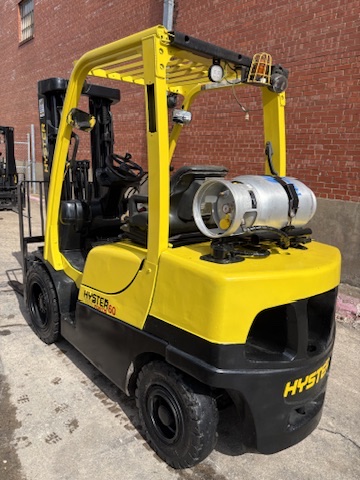
Propane-powered lift trucks feature pressurized gas cylinders mounted on the back of the forklift. They run on an internal combustion engine, which allows them to produce strong torque and go the distance. LPG engines will operate at full power until there is no more fuel in the tank.
- Applications: Mixed indoor/outdoor facilities ( warehouses with outdoor loading docks), two and three-shift manufacturing facilities.
- Supporting Infrastructure: Outdoor propane storage cage for spare cylinders and fuel vendor who will deliver or refill cylinders on-site.
Diesel Forklifts
Diesel engines are the workhorse of material handling. These large machines offer the greatest tractive effort (traction), lifting capabilities, and torque to conquer any job.
- Applications: Industrial sites, lumber yards, scrap yards, loading docks, outdoor construction sites.
- Supporting Infrastructure: On-site diesel fuel pump or bulk storage tank that meets environmental spill regulations.
Performance and Environmental Capabilities
With such drastic mechanical differences between electric batteries and internal combustion engines, you may wonder how each power source excels in its application.
Indoor Air Quality and Emissions
Electric engines produce no tailpipe emissions, making them ideal for indoor facilities where product contamination could be a concern (food processing plants and pharmaceutical clean rooms). Propane is considered a clean-burning fuel. However, LPG engines still produce carbon monoxide and nitrogen oxide emissions that could impact indoor air quality. Diesel forklifts create the largest tailpipe pollutants, restricting them to outdoor applications.
Terrain
Both tires and chassis height play key roles in ground clearance. Electric warehouse lifts are typically equipped with smooth cushion tires or small pneumatic tires. This makes them perfect for smooth concrete warehouses, but difficult to drive on dirt, sand, gravel, or slippery surfaces. Using an electric lift outside or in soft terrain can put heavy strain on the motors and battery.
LPG and diesel units are usually equipped with larger pneumatic tires and have higher ground clearance than their electric counterparts. These features allow for easier navigation through deep holes, gravel, mud, and inclined yards.
Weather and Temperature
Rain, snow, hot, and cold have varying impacts on fuel efficiency. Internal combustion engines can typically withstand harsh rainstorms, below freezing temperatures, and triple-digit weather with proper maintenance. Electrical components don’t fare as well, but with a little preparation, you can safely run electric forklifts in most conditions.
Heavy rain will require electric forklifts to have their wiring properly sealed and a slip-proof operator enclosure. Hot weather will cause battery degradation during lengthy charging periods, and battery capacity can temporarily decrease up to thirty percent in cold temperatures.
Financial Analysis | Acquisition vs. Operational Expenses
Now it’s time to examine how each power source stacks up in terms of upfront costs and cost to operate per hour.
| Power Source | Pros | Cons |
|---|---|---|
| Electric | Lowest Hourly Fuel Expense ($1.50 – $2.50/hr)
Lower Maintenance Requirements |
Higher Initial Upfront Cost (Battery + Charger)
Battery degradation over time |
| LPG | Low Upfront Cost
Fast Refueling (cylinder swap < 5 mins) |
Fuel Price Volatility
Hourly Fuel Cost ($3.00 – $4.00/hr) |
| Diesel | Can Handle the Most Abuse
Long Asset Life |
Highest Fuel Costs ($3.50 – $5.00/hr)
Routine maintenance and engine degradation |
Although purchasing an electric lift truck requires more initial capital for the battery and charging station, it offers the lowest hourly operating cost. Propane and diesel units may cost less upfront, but your operation will be subject to propane gas and fuel price swings.
Interactive Fleet Quiz | What Power Source Should You Choose?
Take our quiz to quickly identify the right power source for your facility.
- Where will the equipment spend more than eighty percent of its operating time?
- Indoors on flat surfaces
- Indoors and outdoors ( loading docks)
- Outdoors (off pavement)
- How many consecutive shifts does your facility run?
- 1 shift (8 hours)
- 2+ shifts (16 to 24-hour day)
- Continuous duty
- What is your primary power concern?
- Zero emissions and noise.
- Refueling Speed
- Lift Capabilities
A-A-A: Electric Power Source
A battery electric forklift will thrive in your operation. They provide the safest and most cost-effective solution for indoor facilities. Contact our dealers today to see how we can help you choose the right electric lift truck at the best price.
B-B-B: LP Source
If your operation leverages multiple shifts and requires fast refueling, propane is the way to go. Swap out cylinders in minutes and never worry about your equipment running out of fuel during a shift again.
B-B-A: Electric Power Source
You’ll want to consider electric forklifts for indoor operations that require trucks to return to a charging bay. Our lithium-ion technology charges during operator break times and can quickly “opportunity charge” your batteries.
B-A-C: Diesel Power Source
Your applications call for nothing less than diesel power! Stop by a Dallas or Miami location to talk to our sales team about acquiring a heavy-duty forklift today.
C-C-B: Diesel Power Source
Diesel trucks are the clear choice when you need power and torque to conquer any application. Add on attachments to increase your lift height and boom to those hard-to-reach loads.
Other Mixtures: Choose Depending on Applications
Both power sources would do well in your facility. If you spend equal time indoors and loading docks, narrow aisle reach trucks offer the greatest efficiency. You’ll see the benefits of going electric when it comes to hourly fuel costs. For outdoor or heavy-duty material handling, you’ll want to look into our propane and diesel-powered warehouse lifts.
Step-By-Step Guide to Going Electric
If your goal is to eliminate emissions and reduce hourly fuel costs, making the switch from ICE to electric could save you thousands on power expenses. First things first, you don’t want to simply order electric forklifts and hope your facility’s power grid can support them. Follow this step-by-step process to ensure your facility won’t encounter any unforeseen setbacks.
Step 1 | Understand Your True Power Needs
The last thing you want is for operations to slow down while waiting on a battery to charge. Look at your current hour meter reports and think about how your lifts are used. Do they run constantly for eight hours or sit idle between loads? Once you have a firm grasp on duty cycles you’ll be able to confidently choose the right battery technology.
Step 2 | Audit Building Power Capacity
Head outside and take a look at your facility’s main electrical panel. Fast chargers and stations with multiple plug-ins require high amps. Verify your building can supply the additional electrical load prior to investing in electric machinery.
Step 3 | Plan Charging Infrastructure
Designate a charging zone away from high-traffic areas. Lead-acid batteries require hydrogen gas to dissipate after charging, so proper ventilation is needed. You’ll also need eye-wash stations and spill kits in the event of an electrolyte battery rupture. If you opt for lithium-ion batteries, you won’t need specialized ventilation, but do need several opportunity charging ports close to break areas.
Step 4 | Teach Your Operators
Electric motors provide instant torque, which sounds nice until you realize every driver will be accelerating from a dead stop. Train operators on proper plug-in procedures and best practices to avoid deep discharges (below 20% battery capacity). Electric motors are quiet so remind pedestrians to watch for forklifts when walking through your warehouse.
Call On 4K Lifts | The Alternative Equipment Solution
Selecting used forklifts and material handling equipment shouldn’t be stressful or expensive. At 4K Lifts, we make the buying process simple by offering friendly service, affordable pricing, and flexible ownership options.
We service warehouses throughout the Dallas, Texas, and Miami-Dade areas and have access to over 300 units at any given time. Need an electric pallet jack for high bay storage? Give us a call! We probably have the exact used lift truck you need in stock and ready for delivery.
Our flexible finance programs allow you to tailor monthly payments to fit your budget. We even offer a 30-day exchange policy if your equipment doesn’t work out.
Still have questions? Contact the Dallas or Miami office today and let our sales team help you find the perfect used forklift for your facility’s unique power needs.
FAQ
Q. Are electric forklifts meant for indoor use only?
Electric forklifts can be used outdoors if they’re equipped with pneumatic tires to prevent the forklift from slipping. Due to sensitive battery components and drive motors, electrical forklifts should always be operated in areas protected from rain, dust, and moisture.
Q. Can you operate an LPG Forklift indoors?
LPG engines fall under the OSHA Ventilation Standard 1910.178, which requires facilities to take active measures to prevent indoor carbon monoxide levels from exceeding 50 parts per million during an eight-hour shift.
Q. How long does it take to recharge an electric battery?
Switching out an LPG tank will take less than five minutes. An electric battery typically takes six to eight hours to recharge, although there are lithium-ion batteries on the market that offer fast “opportunity charging.”