Step into any bustling warehouse, distribution center, or manufacturing plant, and you’ll feel it — a palpable hum of productivity. It’s a carefully choreographed ballet of goods being received, stored, moved, and shipped. At the very heart of this intricate dance are the powerful, versatile machines that make it all possible the forklifts. These are the unsung heroes, the workhorses that lift the heavy loads and keep the gears of commerce turning. From the outside, they might all look similar, but for those in the industry, we know that choosing the right piece of equipment is a critical decision that directly impacts efficiency, safety, and the bottom line.
Think of your warehouse as a unique ecosystem. The layout of your racking, the width of your aisles, the weight of your pallets, and the height of your shelves all create a specific environment. The forklift isn’t just a tool; it’s a species adapted to thrive in that specific habitat. Using the wrong one is like trying to fit a square peg in a round hole—it leads to inefficiency, potential product damage, and safety risks. Understanding the nuances between a nimble pallet jack and a towering reach truck, or the specific applications of a sit-down forklift versus a stand-up forklift, is fundamental to optimizing your workflow.
In this in-depth guide, we will pull back the curtain on the most common types of warehouse forklifts. We’ll move beyond the basics and explore the specific designs, intended purposes, and unique advantages of each machine. Whether you are setting up a new facility or re-evaluating your current fleet, this journey will equip you with the knowledge to select the perfect mechanical partners for your team and transform your material handling operations.
The Classic Counterbalance Sit-Down Forklift
When most people picture a forklift, they are thinking of the classic counterbalance sit-down forklift. This machine is the undisputed icon of the material handling world, and for good reason. It’s versatile, powerful, and found in nearly every type of warehouse environment, from small business stockrooms to massive distribution centers.
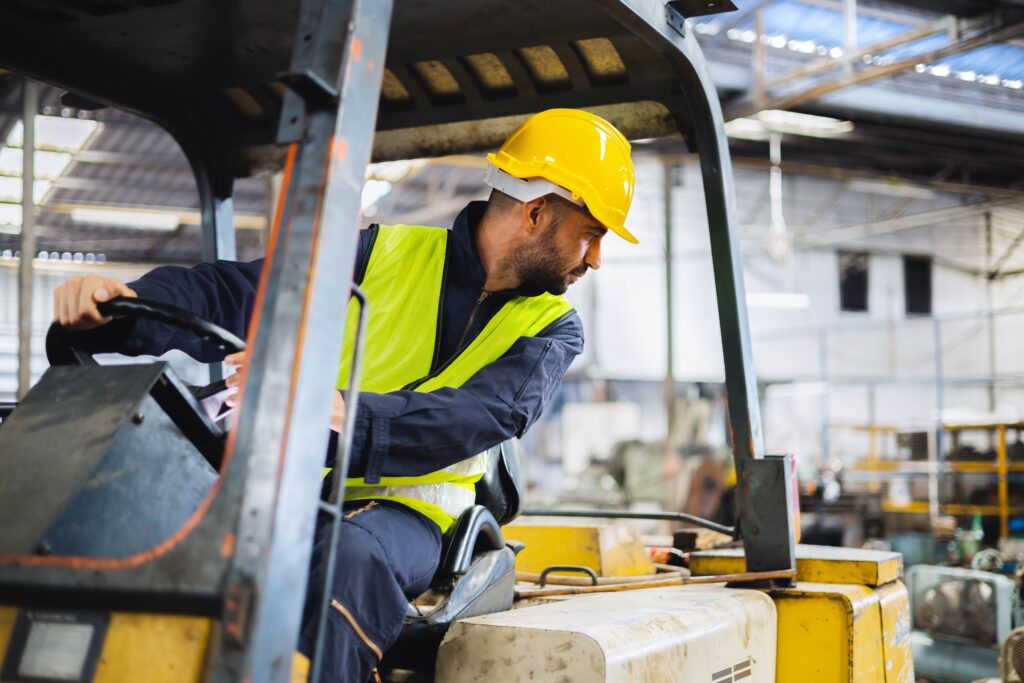
The genius of its design lies in its name. The “counterbalance” is a massive weight, typically cast iron, integrated into the rear of the machine. This weight counteracts the load being lifted on the forks at the front, allowing the forklift to operate without the need for outrigger arms. The operator sits in a comfortable cab, much like a car, with familiar controls like a steering wheel, pedals, and levers, making it relatively intuitive for new operators to learn.
A sit-down forklift is the multi-tool of the warehouse. It’s the go-to machine for loading and unloading tractor-trailers, moving pallets from the receiving dock to staging areas, and general transport of goods around the facility. They are available in a wide range of power options, including electric for indoor use, and propane or diesel for outdoor or more demanding applications. While not the most specialized, the sheer flexibility and power of a sit-down forklift make it an indispensable part of almost any fleet.
The Agile Stand-Up Forklift
Now, let’s move into a more specialized environment—one with narrower aisles and a need for greater maneuverability. This is the domain of the stand-up forklift, also known as a stand-on or stand-on rider forklift. As the name implies, the operator stands on a platform rather than sitting down. This seemingly small change has a massive impact on the machine’s functionality.
The primary advantage of a stand-up forklift is its compact chassis and tighter turning radius. Because the operator is standing, they can easily hop on and off the machine, which is incredibly efficient for tasks that require frequent stops, like picking individual orders or scanning barcodes on multiple pallets. This on-and-off capability saves valuable seconds with every stop, which adds up to significant time savings over a full shift.
We often see a stand-up forklift deployed in situations where an operator needs to work on both sides of an aisle without turning the machine around completely. The operator’s standing position gives them better visibility in a congested area and allows them to simply look over their shoulder to navigate in reverse. They are almost exclusively electric, making them perfect for indoor operations where air quality is a concern. For warehouses focused on speed and maneuverability in tight spaces, the stand-up forklift is a true champion of efficiency.
The Pallet Jack — Ground-Level Efficiency
Not every task involves lifting a pallet 30 feet into the air. For the crucial work of moving pallets at ground level, there is no tool more efficient or ubiquitous than the humble pallet jack. While it may not have the towering mast of its larger cousins, its impact on workflow is just as significant.
The pallet jack, also called a pallet truck or pump truck, comes in two main varieties: manual and electric. Manual pallet jacks are operated by hand. The user slides the forks into a pallet, pumps the handle to lift the load a few inches off the ground, and then manually pushes or pulls the load to its destination. They are perfect for short distances, like unloading a delivery truck or moving pallets around a retail sales floor.
The electric pallet jack takes this concept and adds a battery-powered motor for both lifting and propulsion. This dramatically reduces operator fatigue and allows for the easy movement of heavier loads over longer distances within the warehouse. Electric pallet jacks are workhorses on the loading dock, in staging areas, and for loading pallets into trailers in a precise order. Their small size, ease of use, and low cost make the pallet jack an absolutely essential tool for virtually any business that handles palletized goods. It is the fundamental first step in any efficient material handling strategy.
The Specialized Reach Truck
As warehouses have grown taller to maximize storage density, a new breed of forklift was needed to work in the narrow aisles between towering racks. Enter the reach truck. This is a highly specialized machine designed for one primary purpose: putting away and retrieving pallets from high-level racking in narrow aisle configurations.
The key feature of a reach truck is its unique mast mechanism. The forks are mounted on a pantograph system that allows them to “reach” forward, away from the body of the machine, to pick up or deposit a load. The truck itself can pull up parallel to the racking, and the forks extend into the bay. This eliminates the need for the forklift to make a wide 90-degree turn into the rack, which is what allows for much narrower aisle widths, dramatically increasing the storage capacity of a warehouse.
The operator of a reach truck stands sideways, giving them excellent visibility both forward and backward. These machines are engineered for stability at extreme heights, capable of lifting loads up to 40 feet or more. You will almost always find a reach truck in high-volume distribution centers and storage facilities where maximizing every square foot of space is a top priority. While it isn’t used for loading trucks or long-distance transport, for its specific job of high-level, narrow-aisle storage, the reach truck is peerless.
How to Choose the Right Forklift for Your Operations
Selecting the perfect mix of equipment for your fleet can seem complex, but it becomes much clearer when you systematically analyze your operational needs. Here’s a breakdown of the key factors we guide our partners to consider:
Environment and Terrain
Where will the forklift be used? A sit-down forklift with pneumatic tires is great for indoor/outdoor use, while electric models with cushion tires, like a stand-up forklift or reach truck, are designed for smooth indoor concrete floors.
Load Capacity and Dimensions
What is the average and maximum weight of the pallets you handle? Every forklift has a rated capacity that should never be exceeded. Also, consider the dimensions of your typical load to the proper fork length and load center.
Aisle Width
This is a critical factor. Measure your aisle widths carefully. Standard aisles (11 feet or wider) can accommodate a sit-down forklift, while narrow aisles (8-10 feet) may require a stand-up forklift or reach truck to operate safely and efficiently.
Overhead Clearance
How high are your top racks? This will determine the required mast height for your forklift. Equally important is to measure your lowest overhead clearance, like doorways or sprinkler systems, to what the forklift’s collapsed mast height must be.
Fuel Type
Electric forklifts are quiet, emission-free, and have a lower cost of operation, making them ideal for indoor use. Propane (LPG) forklifts offer powerful performance and can be refueled in minutes, making them great for multi-shift or indoor/outdoor applications.
Let’s Optimize Your Fleet
In the complex ecosystem of a modern warehouse, forklifts are more than just machines; they are the lifeblood of the operation. From the raw power of a sit-down forklift on the loading dock to the specialized agility of a reach truck in a narrow aisle, each type plays a vital role. The efficiency of a stand-up forklift in order-picking tasks and the fundamental utility of a pallet jack for ground-level movement all contribute to a seamless and productive workflow.
Making the right choice is not about finding the “best” forklift—it’s about finding the right forklift for the specific job at hand. By carefully analyzing your space, your products, and your processes, you can assemble a fleet that works in perfect harmony with your operations. This strategic investment in the right equipment will pay dividends in the form of increased productivity, improved safety, and a more efficient, profitable business.
Feeling overwhelmed by the options? Not sure if a stand-up forklift or a reach truck is the right fit for your narrow aisles? Let our team of material handling experts help. Contact us today for a complimentary fleet assessment. We’ll analyze your unique operational needs and help you build the most efficient and cost-effective forklift fleet for your warehouse.
Frequently Asked Questions
Q. What is the main difference between a sit-down forklift and a stand-up forklift?
The primary difference is the operator’s orientation and the resulting design. A sit-down forklift is designed for general-purpose work and longer travel distances, with the operator seated. A stand-up forklift has a smaller chassis and a tighter turning radius, making it more maneuverable in confined spaces. It’s ideal for tasks requiring the operator to get on and off frequently.
Q. When should I use a reach truck?
A reach truck is specifically designed for narrow-aisle warehouses with high racking. You should use a reach truck when your primary goal is to maximize storage density. Its ability to extend its forks into racking without turning the entire machine allows for much narrower aisles than a standard forklift can navigate.
Q. Is a pallet jack considered a forklift?
Yes, a pallet jack is considered a Class III forklift by the Occupational Safety and Health Administration (OSHA). While it may not lift loads as high as other types, it is still a piece of powered industrial equipment used to lift and move palletized loads, and operators should be properly trained and certified.