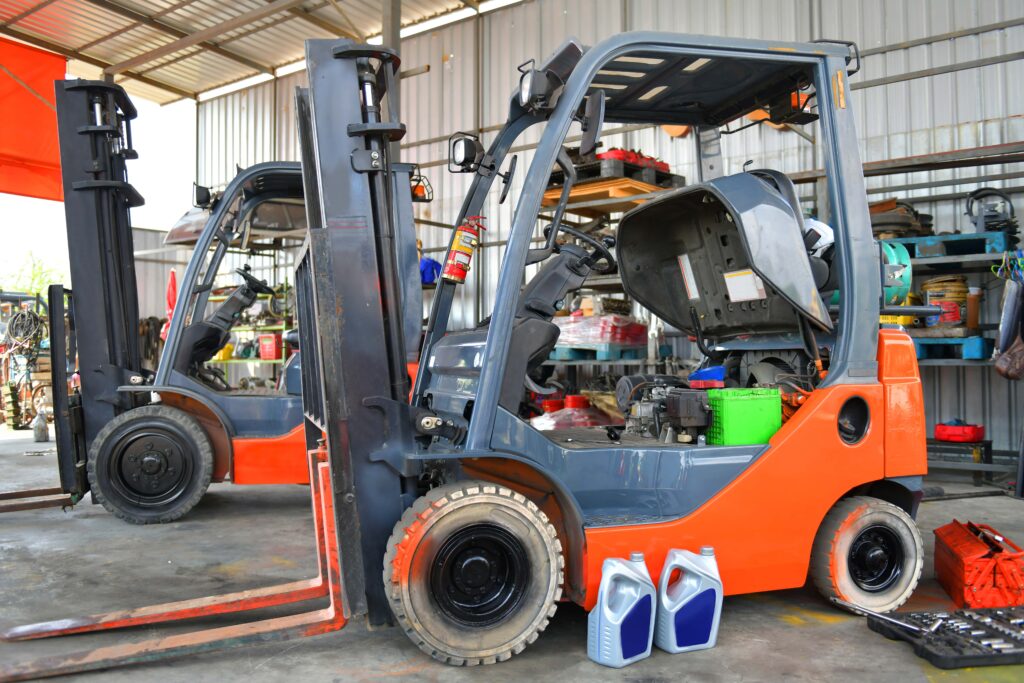
It’s 8:00 AM on a Monday. The warehouse floor is buzzing with the start-of-shift energy. Orders from the weekend are piled up, and the loading dock is stage-set for a record shipping day. Then, silence. Not the good kind. The distinct, grinding halt of your primary 5,000-lb forklift failing in the middle of the main aisle.
The hydraulic line has burst again. This is the third time in two months. Now, instead of moving product, your warehouse manager is on the phone with a technician, and your best operator is sweeping floors while waiting for a rental that might not arrive until noon.
At 4K Lifts, we have seen this scenario play out too many times. It is the classic result of a reactive approach to equipment management. We know that the difference between a chaotic warehouse and a highly profitable one often comes down to one thing: a proactive forklift replacement strategy.
In this post, we will explore exactly how to build a data-driven replacement plan that reduces maintenance costs, maximizes fleet uptime, and turns your material handling equipment into a competitive advantage rather than a liability.
The Hidden Costs of Hanging On
Many businesses hold onto forklifts far past their prime, believing that a paid-off asset is cheaper than a new monthly lease payment. This is often a financial mirage. While you may not have a lease invoice, the invisible costs of an aging fleet are slowly bleeding your budget dry.
When we analyze fleet data, we often find that the maintenance costs for a forklift older than seven years can be up to double that of a newer unit. But the direct repair bills are just the tip of the iceberg.
Downtime and Productivity Loss
Every hour a forklift sits idle in the service bay is an hour it is not moving product. If a truck goes down during peak season, the cost of delayed shipments and overtime wages to catch up can dwarf the cost of the repair itself. A solid forklift fleet management plan accounts for this “opportunity cost” of downtime.
Safety and Morale
Older equipment lacks modern ergonomic and safety features. Worn seats, stiff hydraulic levers, and frequent breakdowns frustrate operators, leading to fatigue and lower morale. Furthermore, as components wear out, the risk of safety incidents increases. An effective replacement strategy is also a safety strategy.
Defining the Economic Life of a Forklift
To implement a strategy, we must first agree on when a forklift is truly “done.” This is known as its economic life.
The economic life of a forklift is the point where the cost to keep it running exceeds the cost of replacing it. For most internal combustion (IC) forklifts, this is typically around 10,000 to 12,000 hours. For electric trucks, it might stretch to 12,000 or 15,000 hours, depending on the battery care.
Think of it like a bathtub curve. In the beginning, costs are low (warranty period). In the middle, costs are stable. At the end, costs rise exponentially. Our goal at 4K Lifts is to help you identify that exact moment before the curve spikes, allowing you to cycle out equipment before it becomes a money pit.
Key Indicators It Is Time to Replace
You do not need to guess. Your forklifts are generating data every day that tells you when they are ready to retire. We recommend tracking these specific metrics to inform your repair vs replace forklift decisions.
1. Maintenance Cost Thresholds
A common industry standard is the “Maintenance Cost limit.” If you are spending more than $4.00 per hour on maintenance (excluding preventative maintenance) over a rolling 12-month period, the unit is likely costing you more than a new one.
Another solid benchmark is the 50% rule. If a single repair quote exceeds 50% of the forklift’s current trade-in value, it is usually time to let it go.
2. Utilization Rates
Are your forklifts being used enough to justify their existence? Or are they being overused? A truck running 2,000 hours a year will reach its replacement age in five years. If you have a truck running only 500 hours, it might last 15 years, but it might also be tying up capital that could be used elsewhere.
3. Obsolescence
Sometimes, the truck runs fine, but it simply cannot get parts anymore. If your technicians are scouring eBay for a control board because the manufacturer stopped supporting that model five years ago, your fleet uptime is at serious risk.
Step-by-Step | Building Your Replacement Strategy
Now that we understand the “why” and “when,” let us look at the “how.” Implementing a robust forklift replacement strategy involves four distinct phases.
Phase 1 | The Fleet Audit
You cannot manage what you do not measure. We start by building a comprehensive fleet profile. This involves physically inspecting every unit and recording:
- Make, Model, and Serial Number
- Age (in years)
- Current Hour Meter Reading
- Cumulative Maintenance Costs (Life-to-date)
- Application Severity (Is it in a clean warehouse or a dusty foundry?)
This audit gives us a snapshot of your current reality. We often discover “ghost” trucks—units that are rarely used but are still being insured and inspected, draining resources unnecessarily.
Phase 2 | Data Analysis and Categorization
With the audit data in hand, we categorize your fleet into three buckets:
- Retain: Newer units with low costs. Keep these on standard preventative maintenance.
- Watch: Units approaching the 10,000-hour mark or showing rising cost trends. these need close monitoring.
- Replace: Units that have exceeded their economic life, have safety issues, or are costing more to run than to replace.
This segmentation allows us to prioritize capital expenditure. You do not need to replace the whole fleet at once; you just need to attack the “Replace” bucket first.
Phase 3 | Standardization
One of the most overlooked aspects of forklift fleet management is standardization. If you have five different brands of forklifts, you have five different sets of parts to stock, five different diagnostic tools needed, and five different operator control layouts.
As we plan your replacements, we look for opportunities to consolidate. Moving to a single manufacturer or a standardized set of models simplifies training and drastically reduces parts inventory. It also gives you better leverage when negotiating purchase or lease terms.
Phase 4 | Financial Modeling
This is where we align the strategy with your CFO’s goals. We compare the Total Cost of Ownership (TCO) of the current fleet against a proposed new fleet. We look at:
- Lease vs. Buy: Leasing often provides a lower barrier to entry and a structured replacement cycle (e.g., every 5 years), forcing discipline into the strategy. Buying might be better for low-utilization units.
- Energy Savings: Switching from aging propane trucks to modern lithium-ion electrics can save thousands in fuel and maintenance, often offsetting the cost of the new lease.
The Role of Planned Replacement
The ultimate goal is to move from “breakdown replacement” to “planned replacement.”
In a planned replacement model, new equipment is ordered months in advance of the old unit’s retirement date. This prevents the panic of a breakdown. It allows for a seamless transition where the new truck arrives, the old one is traded in, and production never skips a beat.
This approach also maximizes your forklift trade-in value. A running truck with valid certification is worth significantly more than a non-running unit with a blown transmission. By trading it in before catastrophic failure, you recover equity that can be applied to the new lease.
Navigating the Repair vs Replace Decision
Even with a strategy, edge cases arise. You might have a 6-year-old truck that needs a $3,000 transmission repair. Is it worth it?
We use a simple matrix to help clients decide:
- If the truck is < 5 years old and hours are low: Repair it.
- If the truck is > 7 years old and hours are high: Replace it.
The Gray Area: If it is in the middle, we look at the history. Has this truck been a “lemon”? Are parts readily available? If the repair extends the life by at least 12 months without further major investment, we might repair. If not, we cut our losses.
Consider reading more about replacement guidelines from authoritative sources like Industrial Forklift Truck or checking OSHA’s eTool for safety requirements regarding aging equipment.
Why 4K Lifts is Your Strategic Partner
Implementing this level of strategy requires time and expertise that many warehouse managers simply do not have. That is where we come in.
At 4K Lifts, we do not just sell forklifts; we manage fleets. We act as an extension of your operations team. We perform the audits, we crunch the maintenance numbers, and we present you with clear, ROI-focused options.
We help you navigate the complexities of modern material handling equipment, from selecting the right fuel source to optimizing aisle widths for your new machines. Our goal is to ensure your fleet is lean, reliable, and safe.
A forklift replacement strategy is not just about buying new trucks; it is about protecting your production schedule and your bottom line. By shifting from a reactive “fix-it-when-it-breaks” mentality to a proactive, data-driven lifecycle management approach, you can reduce operating costs, improve safety, and ensure your team always has the tools they need to succeed.
Do not let an aging fleet anchor your business efficiency. The cost of doing nothing is often higher than the investment in modernization.
Ready to stop the bleeding on maintenance costs? Visit 4K Lifts today.
Frequently Asked Questions
Q. What is the typical economic life of a forklift?
The economic life of a forklift is generally between 10,000 and 12,000 hours for internal combustion models, and up to 15,000 hours for electric models. Beyond this point, maintenance costs usually rise significantly, making replacement the more cost-effective option.
Q. How do I calculate the maintenance cost per hour?
To calculate maintenance cost per hour, take the total amount spent on repairs and maintenance (parts and labor) over a specific period (e.g., one year) and divide it by the number of hours the forklift was operated during that same period.
Q. Should I lease or buy my replacement forklifts?
Leasing is often preferred for high-utilization fleets because it offers a lower upfront cost and enforces a disciplined replacement cycle, ensuring you always have modern equipment. Buying is typically better for low-usage applications where the equipment will not accrue hours quickly and can be kept for many years.
Q. How does a forklift replacement strategy improve safety?
Newer forklifts come equipped with the latest safety technology, such as better stability controls, improved visibility, and ergonomic features that reduce operator fatigue. replacing older, worn-out equipment reduces the risk of mechanical failures that could lead to accidents or injuries.